
Your power keeps tripping because a protective device in your consumer unit is doing its job: cutting the circuit the instant it senses an overload, a short circuit, or current leaking to earth. The trip is the symptom, not the fault. Something on that circuit, a faulty appliance, an overloaded socket, moisture, or ageing wiring, is triggering it.
This guide walks through the most common reasons your power keeps tripping in a Singapore home, what you can safely check yourself, and the exact point where resetting the breaker again becomes dangerous rather than helpful. You will finish knowing whether it is a quick fix or a call to a licensed electrician.
What a Trip Actually Means in Your Distribution Board
A trip means your distribution board (DB box) shuts off a circuit to stop it from overheating or to protect someone from a shock. In most Singapore HDB flats and condos, the DB box sits by the main door and holds three types of protective devices, and knowing which one tripped is your first real clue.
The MCB (miniature circuit breaker) guards the wiring against overload and short circuits. The RCCB (residual current circuit breaker), sometimes still called an ELCB, protects people by cutting power within milliseconds when it detects current leaking to earth. Newer boards use an RCBO, which combines both jobs on a single circuit, so only the affected circuit drops instead of the whole flat.
If you want the full breakdown of how these three devices differ and why each one trips, our guide comparing an RCCB, MCB and RCBO explains it in plain language. For now, note which device moved before you touch anything.
The 7 Most Common Reasons Your Power Keeps Tripping
Most repeat trips trace back to one of seven causes. They are ordered here from the most common and easiest to check, to the ones that need a professional.
1. Overloaded circuit
This is the top cause in Singapore homes. An overloaded circuit happens when the total load drawn exceeds what the wiring can safely carry, so the MCB trips to stop the cables overheating. The classic trigger is the kitchen: kettle, air fryer, microwave, and rice cooker all firing on one circuit. You reset it, it holds, then the kettle goes on and it drops again.
What you can do: unplug everything on that circuit, reset it, then add appliances back one at a time. When the trip returns on a specific combination, you have found your overload. Spreading high-draw appliances across different circuits usually stops it.
2. A single faulty appliance
One appliance with a failing motor, a damaged element, or worn insulation can trip the circuit every time it switches on or reaches a certain point in its cycle. Water heaters, washing machines, kettles, and fridges are the usual culprits in local flats because their motors and elements draw hard on start-up.
What you can do: unplug all appliances, reset, then reconnect and run each one briefly. The circuit trips when the faulty unit comes on. Stop using it until it is repaired or replaced.
3. Short circuit
A short circuit happens when a live wire touches a neutral wire directly, causing a sudden surge that trips the MCB instantly and hard. You might notice a faint burning smell, a small flash, or scorch marks around a socket or plug.
What you can do: check visible plugs and sockets for burning or damage. Do not keep resetting a breaker that drops the instant you flip it. A short in fixed wiring is not a DIY repair.
4. Earth fault, often from moisture
An earth fault is when a live wire makes contact with an earthed surface, a metal casing, a damp wall, or water itself, and the RCCB trips on the imbalance. In Singapore’s humidity, this is common after heavy rain, in bathrooms, kitchens, service yards, and around water heaters. The RCCB drops rather than a single MCB, and it can trip at seemingly random times.
What you can do: look for obvious moisture near sockets, water heater points, or outdoor-facing fittings. Dry the area and see if the tripping stops. If it does not, the fault may be in concealed wiring and needs tracing.
5. Ageing or damaged wiring
Older flats that have not been rewired in decades can have brittle or degraded insulation. When wiring breaks down, it creates the conditions for both overloads and earth faults. Warning signs include warm socket faces, a persistent burning smell with no source, and trips across more than one circuit with no clear pattern. This is a genuine fire risk and needs a professional assessment, sometimes a full house rewiring.
6. Loose connections
Connections at sockets, switches, or inside the DB box can work loose over time. A loose connection adds resistance, generates heat, and causes intermittent trips that are hard to reproduce. A socket that feels warm or a light that flickers before a trip can point here. Work inside the DB box should only be opened by a licensed electrician.
7. A worn RCCB or faulty DB box
Protective devices do not last forever. An RCCB or MCB that has tripped thousands of times, or is simply old, can begin dropping at lower thresholds than it should, or refuse to hold a reset even with no load. Press the T (test) button on your RCCB: it should trip cleanly and reset. If it does not trip when tested, the device itself may no longer be protecting you.
| Do not do thisNever force-reset a breaker repeatedly. It is cutting power for a reason, and overriding it risks overheating and, in the worst case, fire.Never open the DB box cover to poke at wiring. In Singapore, that work is legally reserved for a Licensed Electrical Worker. |
A Simple Step by Step to Find the Cause Yourself
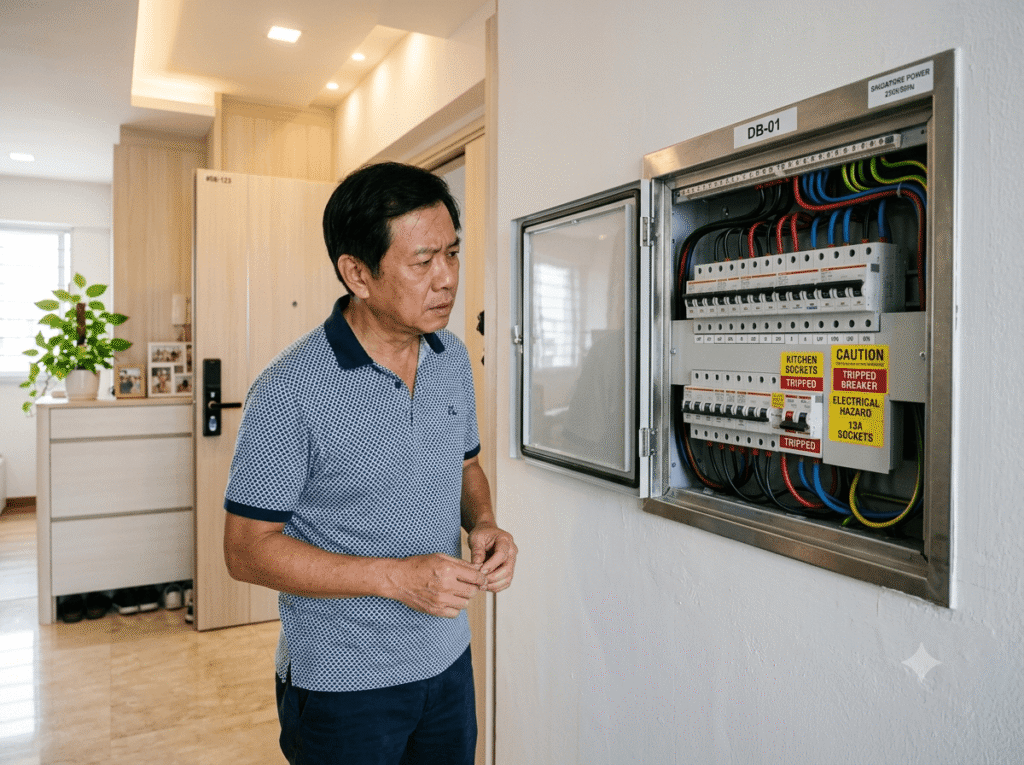
Before you call anyone, work through this safe sequence. It isolates most faults in a few minutes.
- Go to the DB box and see which device tripped, an MCB (small switch), the RCCB (large switch with a T button), or an RCBO. Note the circuit label.
- Unplug everything on the affected circuit.
- Try to reset. If it trips immediately with nothing plugged in, stop. The fault is in the wiring or the device, and you need a licensed electrician.
- If it holds, plug appliances back one at a time, switching each on before adding the next. A trip when a specific appliance comes on identifies that appliance.
- If it holds with everything on but trips again later, note the pattern (time, weather, which appliances) and share it with your electrician.
- If the whole flat went dark, the RCCB tripped. Repeat the unplugging steps across the affected circuits.
Homeowners dealing with repeated night-time trips can read our dedicated power trip repair guide for how our team diagnoses the root cause rather than just resetting the board.
When a Tripping Circuit Becomes an Emergency
Most trips are routine. A few are not. Treat it as urgent and switch the affected circuit off at the DB box if any of these apply:
- A burning smell from the DB box, a socket, or anywhere in the wiring.
- Scorch marks or discoloration around a socket, switch, or the board.
- A bang, flash, or buzzing or crackling sound when it tripped.
- The DB box or a socket feels warm to the touch.
- Water has entered a socket or fitting, or someone received a shock.
These signs point to heat, arcing, or live parts, and they do not wait. A midnight power trip with any of these is exactly the kind of call our 24/7 team handles across the island, usually arriving within 60 to 90 minutes. You can reach a licensed electrician in Singapore any hour through our hotline.
How SG Handyman Engineering Diagnoses and Fixes It
A reset is not a repair. Our EMA-compliant, engineering-trained team traces the actual fault so it does not come back the following week. That means load testing the circuit, checking insulation resistance for hidden earth faults, inspecting the DB box for worn devices, and confirming the fix with proper testing before we leave.
We quote a fixed price before any work starts, so there are no surprises, and minor repairs start from S$50 to S$80. Every job carries a 30 to 90 day workmanship warranty: if the same problem returns in that window, we fix it free. Snap a photo of your DB box, send it over WhatsApp, and you will usually have a quote within the hour. For the full electrical service range, our electrical repair service page lists everything we cover.
| Trip pattern | Most likely cause |
|---|---|
| Trips only when many appliances run | Overloaded circuit |
| Trips when one appliance switches on | Faulty appliance |
| Trips instantly, even with nothing plugged in | Short circuit or wiring fault |
| Whole flat drops, often after rain or in wet areas | Earth fault (RCCB) |
| Random trips across several circuits, older flat | Ageing wiring or worn RCCB |
Frequently Asked Questions
Why does my power keep tripping at night?
Night trips usually come from a specific appliance on a timer or heavy start-up load, such as a water heater or air-conditioner, or from an earth fault in a damp area that worsens overnight. Note what is running when it drops, then isolate that circuit.
Is it safe to keep resetting a tripped breaker?
No, not if it keeps tripping. A breaker that drops repeatedly is responding to a real fault, and resetting it again risks overheating and fire. Reset once or twice to test; if it will not hold, stop and get it checked.
Can I fix a tripping circuit myself in an HDB flat?
You can unplug appliances, reset the breaker, and dry out damp sockets. You cannot legally open the DB box or touch fixed wiring. In Singapore, electrical installation work must be done by a Licensed Electrical Worker, a requirement set by the Energy Market Authority to keep homes safe.
Why does my whole flat lose power instead of one room?
That is the RCCB tripping on earth leakage, which cuts everything it protects at once. A single faulty appliance anywhere on those circuits can cause it. Unplug items one by one and reset after each to find the source.
What is the difference between an MCB and RCCB tripping?
An MCB trips on overload or short circuit on one circuit. An RCCB trips on current leaking to earth, which can mean a faulty appliance, damaged insulation, or moisture. Which one moves tells you where to look first.
How do I know if my DB box needs replacing?
Signs include repeated trips with no cause found, breakers that will not hold a reset, a board warm to the touch, or a unit over 25 to 30 years old. HDB flats follow specific rules for such works, outlined in the HDB renovation guidelines, and a licensed electrician can confirm whether replacement is needed.
Does a power trip mean my wiring is dangerous?
Not always. A single overload or one faulty appliance is not dangerous once fixed. But trips across multiple circuits, warm sockets, or a burning smell in an older flat can signal degraded wiring, which does need urgent attention.
How much does it cost to fix a tripping circuit in Singapore?
Minor diagnostics and repairs typically start from S$50 to S$80, with the final price depending on the fault. Our electrician cost guide breaks down typical rates so you know what to expect before booking.
Get to the Root of the Trip, Not Just the Reset
A tripping circuit is your home protecting itself, so the goal is to find what it is protecting you from. Work through the safe checks above: identify the device, unplug, reset once, and reintroduce appliances one at a time. If it trips instantly, trips across circuits, or comes with heat or a smell, that is the moment to bring in a professional rather than reset again.
If your power keeps tripping and you cannot pin down why, send a photo of your DB box to our team for a fast, fixed-price quote, and let an EMA-compliant electrician trace it properly the first time.