
An MCB trips on overload or short circuit, an RCCB trips on current leaking to earth, and an RCBO does both on a single circuit. That one sentence is the whole answer, but which device tripped in your distribution board tells you exactly what went wrong and what to do next.
This guide explains RCCB vs MCB vs RCBO in plain language for Singapore homes, using the devices sitting in your own DB box. You will learn what each one protects against, why it tripped, how to read your board when the power goes, and when the fix is legally a job for a licensed electrician.
What Each Device Actually Does
All three live in your distribution board and all three cut power to keep you safe, but they watch for different problems. Getting the roles clear is what lets you diagnose a trip instead of just resetting blindly.
MCB: the overload and short-circuit guard
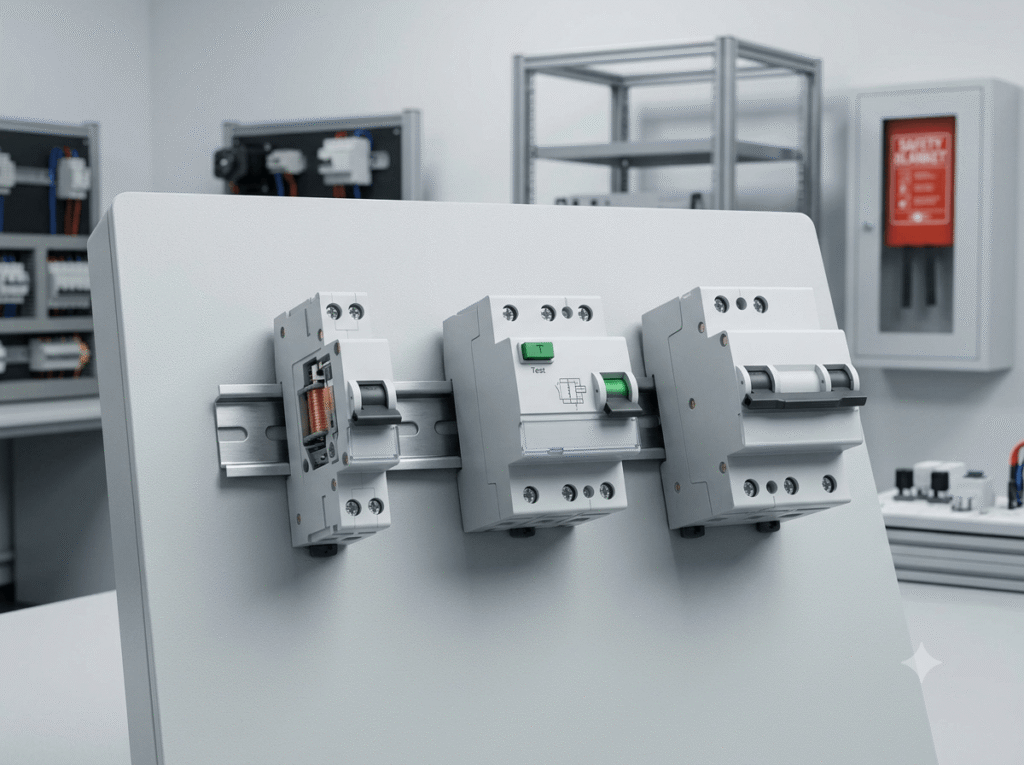
An MCB, or miniature circuit breaker, protects the wiring on a circuit. It trips when too much current flows for too long (an overload) or when a live and neutral wire touches directly (a short circuit). It uses a thermal element for slow overloads and a magnetic element for instant shorts. What it does not do is protect you from a shock, because a small leakage to earth is invisible to it.
RCCB: the shock protector
An RCCB, or residual current circuit breaker (older Singapore boards call it an ELCB), protects people. It constantly compares the current flowing out on the live wire with the current returning on the neutral. In a healthy circuit they match. If some current is leaking to earth, through a faulty appliance, damaged insulation, or a person, the balance breaks and the RCCB cuts power in milliseconds. It does not protect against overload or short circuit on its own.
RCBO: both in one
An RCBO, or residual current breaker with overcurrent protection, combines the MCB and the RCCB into a single module for one circuit. Because each circuit has its own RCBO, a fault trips only that circuit instead of taking down everything the way a single shared RCCB does. It costs more per circuit but makes fault-finding far easier, which is why modern DB boards increasingly use one RCBO per circuit.
| Device | Protects against |
|---|---|
| MCB | Overload and short circuit (equipment) |
| RCCB | Earth leakage / electric shock (people) |
| RCBO | Overload, short circuit and earth leakage (both) |
Which One Tripped, and What It Is Telling You
The device that tripped is a diagnosis in itself. Read your board before you touch anything, and use this to interpret it.
- A small single switch dropped, one zone dark: an MCB. The cause is overload (too many appliances) or a short circuit on that circuit.
- One large switch dropped, whole flat or a big section dark: the RCCB. The cause is earth leakage somewhere on the circuits it covers, often a faulty appliance or moisture.
- Only one circuit dropped on a modern board: an RCBO isolating a single fault, which could be either overcurrent or leakage on that circuit.
If your whole flat goes dark whenever one appliance is used, that is the classic RCCB-catching-an-earth-fault pattern. Our guide on why power keeps tripping walks through isolating that appliance step by step.
| Test your RCCBPress the T (test) button on the RCCB about once a month. It should trip instantly and reset cleanly.If it does not trip when tested, it may no longer be protecting you and should be checked by a licensed electrician. |
Why It Matters in a Singapore HDB Flat or Condo
This is not just theory. In Singapore’s climate and housing, the difference between these devices is practical and, in the case of the RCCB, safety-critical.
Humidity and wet areas make earth leakage common. Bathrooms, kitchens, service yards, and water heater points are exactly where an RCCB earns its place, because a live wire meeting a damp surface is a real shock risk. That is also why local practice, following the code of practice for electrical installations, places RCCB or RCBO protection on these circuits. Older HDB flats may still run an ELCB, an earlier form of the RCCB, and upgrading it is common during a rewiring.
Whether you need an RCCB upgrade, an RCBO conversion, or a DB box replacement, that work must be done by a licensed electrician. Our electrical repair team handles DB box upgrades and RCCB testing across the island, and for a full board replacement our house rewiring service covers it end to end.
RCBO or MCB Plus RCCB: Which Setup Is Better
When a board is designed or upgraded, there are two common approaches, and each has a trade-off.
A single RCCB feeding several MCBs is the more economical layout. One RCCB protects a group of circuits, with an MCB on each for overcurrent. The downside is that any earth fault trips the shared RCCB, so several circuits go dark at once and fault-finding is slower.
One RCBO per circuit costs more and takes more space in the board, but a fault isolates to a single circuit. The rest of the home keeps running, and you know immediately where the problem is. For most modern homes that value uptime and easy diagnosis, per-circuit RCBOs are the preferred choice, especially on high-risk circuits like the kitchen, bathroom, and water heater.
| Setup | Best when |
|---|---|
| Single RCCB + MCBs | Budget-sensitive, many non-critical circuits grouped together |
| One RCBO per circuit | You want fault isolation, uptime, and fast diagnosis |
How SG Handyman Engineering Helps
Choosing and installing the right protective devices is not guesswork, and it is not a DIY job in Singapore. Our engineering-trained, EMA-compliant team assesses your board, tests your existing RCCB, recommends whether an RCBO upgrade makes sense for your circuits, and installs it with proper testing before we leave. You get a fixed quote before any work starts, minor works from S$50 to S$80, and a 30 to 90 day workmanship warranty.
If your board is tripping and you are not sure which device is doing it, send a photo of your DB box over WhatsApp for a quick read and a fixed quote. For urgent faults, a licensed electrician in Singapore is available 24/7, or you can reach us through our contact page.
Frequently Asked Questions
Which is better, RCBO or MCB?
They do different jobs, so neither replaces the other. An MCB only guards against overload and short circuit. An RCBO does that and also protects against earth leakage and shock. For a circuit that needs shock protection, an RCBO (or an RCCB paired with an MCB) is the safer choice.
Does an RCCB trip on overload?
No. An RCCB only detects earth leakage, the imbalance between live and neutral current. It does not respond to overload or short circuit, which is why it is paired with an MCB, or replaced by an RCBO, to cover both.
Can I use an RCCB without an MCB?
Not safely on its own. An RCCB gives no overload or short-circuit protection, so circuits still need an MCB upstream or downstream. On high-risk circuits like kitchens and bathrooms, both types of protection are important.
What is the difference between an ELCB and an RCCB?
An ELCB is an older earth-leakage device found in some Singapore HDB flats; the RCCB is its modern successor and detects leakage more reliably. If your flat still has an ELCB, a licensed electrician can advise whether to upgrade during a rewiring.
Do Singapore homes legally need RCCB protection?
Residual current protection is required on relevant circuits under Singapore’s electrical installation rules, and electrical work must be done by a Licensed Electrical Worker registered with the Energy Market Authority. Your appointed electrician assesses the right protection for your installation.
Why does my RCCB trip but my neighbour’s does not?
Because the fault is inside your installation or an appliance, not the supply. A faulty appliance, damp fitting, or degraded insulation on your circuits causes the leakage your RCCB detects. Unplug appliances one by one to find it.
How often should the RCCB be tested?
Press the test button roughly once a month. It should trip and reset cleanly. HDB electrical works, including DB upgrades, follow the rules in the HDB renovation guidelines, so any replacement should be done by a licensed electrician.
Is an RCBO upgrade worth it for an older flat?
Often yes, especially if you want faults to isolate to one circuit rather than dropping the whole flat. It also simplifies diagnosis. An electrician can advise whether your board has the space and whether it pairs well with a rewiring.
Read Your Board With Confidence
Once you know that an MCB guards the wiring, an RCCB guards you, and an RCBO does both, your distribution board stops being a mystery. The device that trips points straight to the type of fault, which saves time and keeps you safe. Test your RCCB monthly, and never keep resetting a device that will not hold.
If your board is tripping and you want to know which device and why, send a photo to our team for a fast read and a fixed-price quote from an EMA-compliant electrician.