
You should avoid DIY electrical repair because in Singapore it is illegal for anyone but a Licensed Electrical Worker to carry out electrical installation work, and the risks, electrocution, fire, voided insurance, and fines up to S$10,000, far outweigh the small savings.
What looks like a simple socket swap or DB fix carries real danger and legal exposure that a homeowner cannot see. This guide lays out the five reasons DIY electrical repair is a mistake in a Singapore home, the few tasks you can safely do, and the smarter, low-cost alternative that keeps your flat safe and compliant.
1. In Singapore, DIY Electrical Work Is Actually Illegal
This is the reason most homeowners do not realise. Under Singapore’s Electricity Act, electrical installation work must be carried out by a Licensed Electrical Worker (LEW). This is not a guideline; it is the law, and it applies whether the job is a new power point or a whole DB box.
Doing it yourself, or hiring an unlicensed handyman, is an offence that can carry fines of up to S$10,000, imprisonment, or both, and the property owner can be held responsible too. This is the single biggest gap in generic online advice: overseas articles talk about permits, but in Singapore the rule is stricter and the penalty is real. If you are unsure whether a job needs a licensed electrician, our guide on EMA-licensed electrician requirements for HDB work explains where the line sits.
2. The Shock and Fire Risk Is Real and Hard to See
Electricity does not give second chances. A shock from a live circuit can cause burns, loss of consciousness, cardiac arrest, and worse. The danger is that an untrained person cannot reliably tell a safe wire from a live one, or spot the conditions that make a circuit hazardous.
Fire is the slower danger. A loose connection, the wrong cable gauge, or a poorly terminated wire may work fine for weeks, then overheat and ignite inside a wall where you cannot see it. In a dense HDB block or condo, an electrical fire is not just your problem, it puts neighbours at risk too. This is exactly the kind of hidden fault our team is trained to prevent.
| Warning signs you should never DIY aroundA burning smell, warm socket, or scorch marks near a fitting or the DB box.A breaker that trips instantly and will not hold, covered in our guide on why power keeps tripping.Buzzing, crackling, or sparks from any outlet or switch. |
3. It Can Void Your Insurance and Fire Coverage
Home and fire insurance policies generally require that electrical work meets the applicable standards and was done by a licensed professional. If a fire or incident is traced to unlicensed or non-compliant DIY work, the insurer can deny the claim, leaving you to cover the damage to your flat, and potentially your neighbours’, out of pocket.
That single risk usually dwarfs any saving from doing it yourself. A repair that cost a few hundred dollars to do properly can turn into a claim worth tens of thousands that your policy will not pay. Documented work from a licensed electrician protects you here, and it is exactly what our electrical repair service provides.
4. Small Mistakes Become Expensive Ones
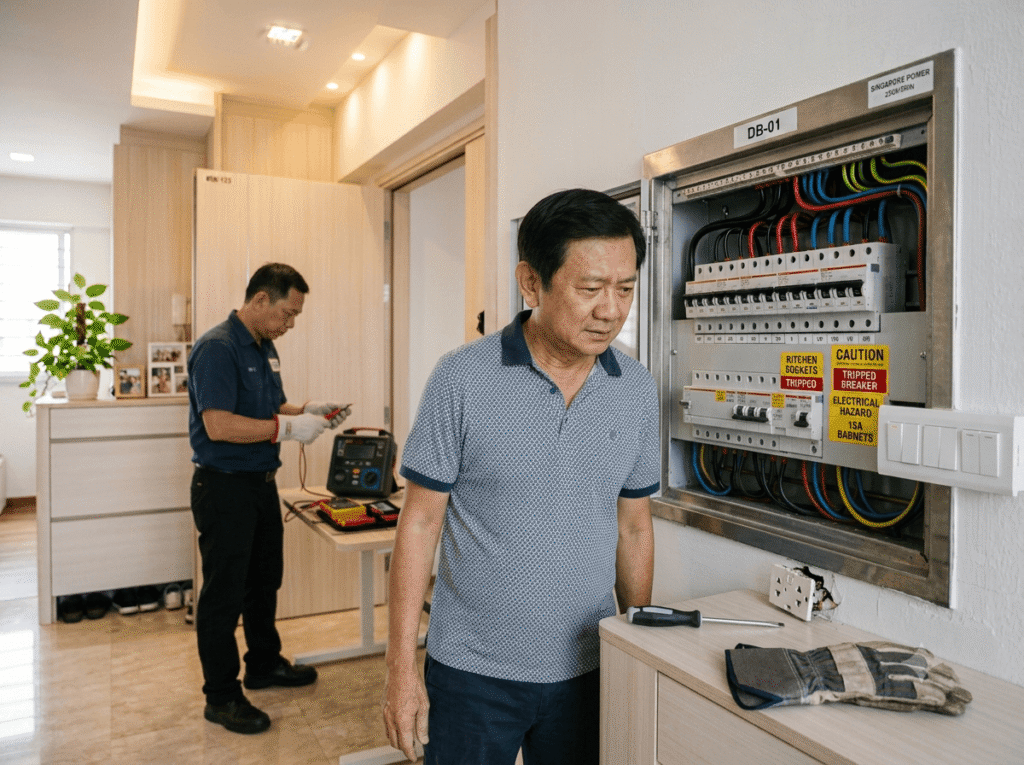
The frustrating pattern with DIY electrical work is that it often seems to succeed. The light comes on, the socket works, and everything looks fine, until it is not. A wrong-gauge wire, a loose terminal, or a missed earth connection can sit quietly for weeks before it surfaces as a tripping circuit, a failed appliance, or a burnt-out fitting.
By then the fix is bigger than the original job, because now there is damage to undo as well as the underlying fault to correct. Using the wrong parts (wrong rating, wrong type, poor quality) compounds it. A licensed electrician diagnoses the root cause first and uses the correct materials, which is why paying once for a proper job beats paying twice for a patch that fails. If cost is your worry, our electrician cost guide shows how affordable a correct repair actually is.
5. It Can Fail HDB, MCST, and Resale Checks
Electrical work in Singapore homes is subject to oversight that DIY cannot satisfy. HDB renovation rules require electrical works to be done by licensed electricians, and unlicensed work can breach those rules. In a condo, the MCST often needs to approve and document electrical works affecting the unit.
When you sell, buyers and their agents frequently commission an electrical check, and non-compliant DIY work can hold up the sale or reduce the price. Proper documentation from a licensed electrician keeps your flat clean on paper as well as safe in practice.
What You Can Safely Do Yourself
Avoiding DIY does not mean you are helpless. A handful of tasks are genuinely safe because they do not involve wiring or connections.
- Reset a tripped breaker (once or twice, to test).
- Replace a plug-in light bulb or tighten one that is loose.
- Unplug appliances to isolate which one is causing a trip.
- Reset a GFCI or RCCB using its own reset button.
- Dry out a damp socket area and monitor whether tripping stops.
Anything beyond this, installing, replacing, or altering wiring, sockets, switches, or the DB box, is licensed work. That is the clean line to hold.
The Smarter, Low-Cost Alternative
The alternative to risky DIY is not an expensive one. Our EMA-compliant, engineering-trained team quotes a fixed price before any work starts, with minor repairs from S$50 to S$80, and backs every job with a 30 to 90 day workmanship warranty. You get the work done legally, safely, and documented, without the gamble.
With over 20,000 projects completed and a 4.9-star rating, we cover the whole island 24/7, with emergency arrival in 60 to 90 minutes. Snap a photo of the problem, send it over WhatsApp, and get a quote within the hour, or reach a licensed electrician in Singapore any time. You can also book a technician directly.
Frequently Asked Questions
Is DIY electrical work illegal in Singapore?
Yes, for installation and wiring. Under the Electricity Act, electrical installation work must be done by a Licensed Electrical Worker registered with the Energy Market Authority. Simple tasks like resetting a breaker or changing a bulb are fine; connections and circuit work are not.
What is the penalty for unlicensed electrical work?
Carrying out electrical installation work without an LEW licence is an offence that can result in fines up to S$10,000, imprisonment, or both. The property owner who engages an unlicensed worker can also be held liable.
Can I change my own power socket or switch?
No. Replacing a socket or switch means working on fixed wiring, which is licensed work in Singapore. It looks simple but carries shock, fire, and legal risk, and it must be done by a licensed electrician.
Will DIY electrical work affect my home insurance?
It can. If unlicensed or non-compliant work causes a fire or incident, your insurer may deny the claim. Documented work by a licensed electrician protects your coverage, which is why the small saving from DIY rarely makes sense.
Can I do electrical work myself in my HDB flat?
No. HDB requires electrical works to be done by licensed electricians, as set out in the HDB renovation guidelines. Unlicensed work can breach HDB rules and affect your flat’s compliance.
What electrical tasks are safe for a homeowner?
Resetting a breaker, changing or tightening a plug-in bulb, unplugging appliances to isolate a fault, and pressing the reset on a GFCI or RCCB. Anything involving wiring, connections, or the DB box is not.
My DIY fix seemed to work, so is it fine?
Not necessarily. Many electrical faults surface weeks later as trips, damaged appliances, or overheating inside walls. A licensed electrician can inspect the work and confirm it is safe and compliant before it becomes a bigger problem.
Is hiring a licensed electrician expensive?
Less than you might think. Minor repairs start from S$50 to S$80, far below the potential cost of a voided insurance claim or a repeat fault. Our electrician cost guide breaks down typical rates.
Keep the Saving, Skip the Risk
DIY electrical repair in a Singapore home is not a money-saver, it is a gamble with your safety, your insurance, and the law. The tasks that are safe for a homeowner are limited to resetting, bulb-changing, and isolating appliances. Everything else belongs with a Licensed Electrical Worker, both because it is required and because it is genuinely safer.
If you have a repair in mind, send a photo to our team for a fixed-price quote and let an EMA-compliant electrician handle it properly, usually for less than you expect.